
Research
AI for Optimization: Fast and Reliable Data-Driven Decision-Making
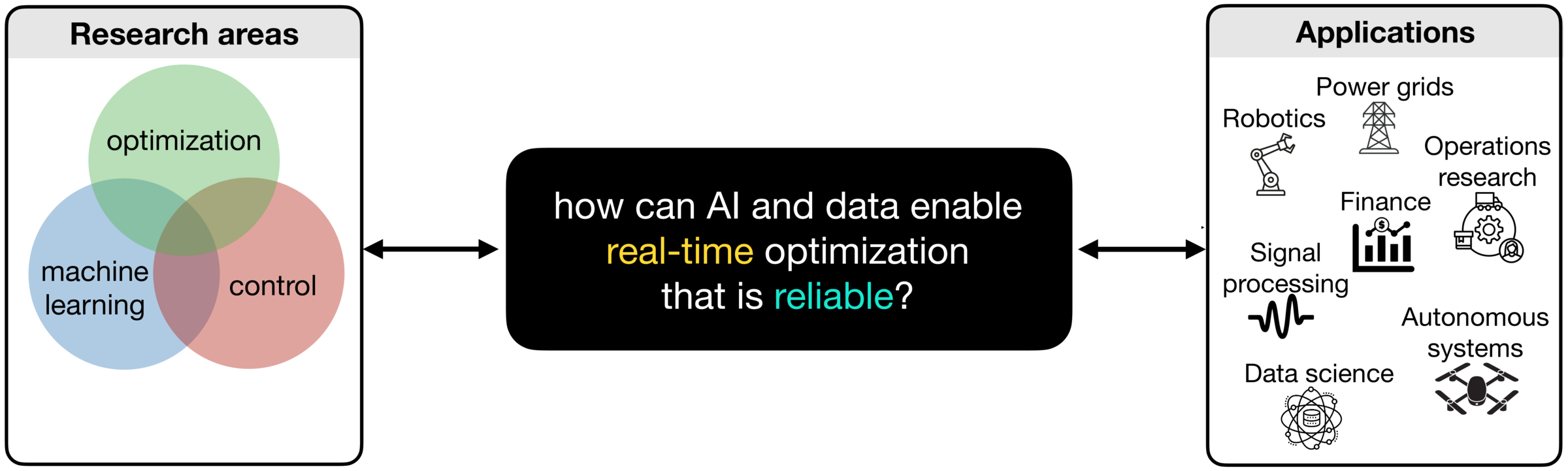
In many high-stakes domains such as autonomous systems, power grids, and signal processing, we must repeatedly solve similar optimization problem instances in real time as conditions change. Mathematically, this means solving the same parametric optimization problem

for a different problem parameter $x$ each time. For example, in control we re-solve for the optimal inputs as the initial state changes. In power systems, we re-solve for network power flows as demand and renewable generation shift.
Classical algorithms solve each instance from scratch, ignoring the structure shared across the family. Data offers a way to exploit that structure: to build faster algorithms, derive tighter performance guarantees, and characterize complex systems in which optimization one part among many. This motivates my overarching research question:
Research agenda
I am currently organizing my work around three connected directions.
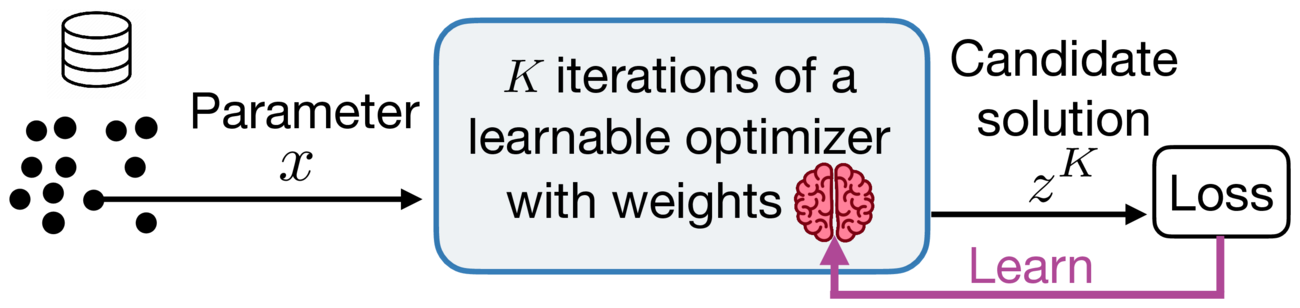
I develop learned optimizers that warm-start or accelerate classical iterative algorithms, while preserving the convergence and correctness guarantees that make those algorithms trustworthy.
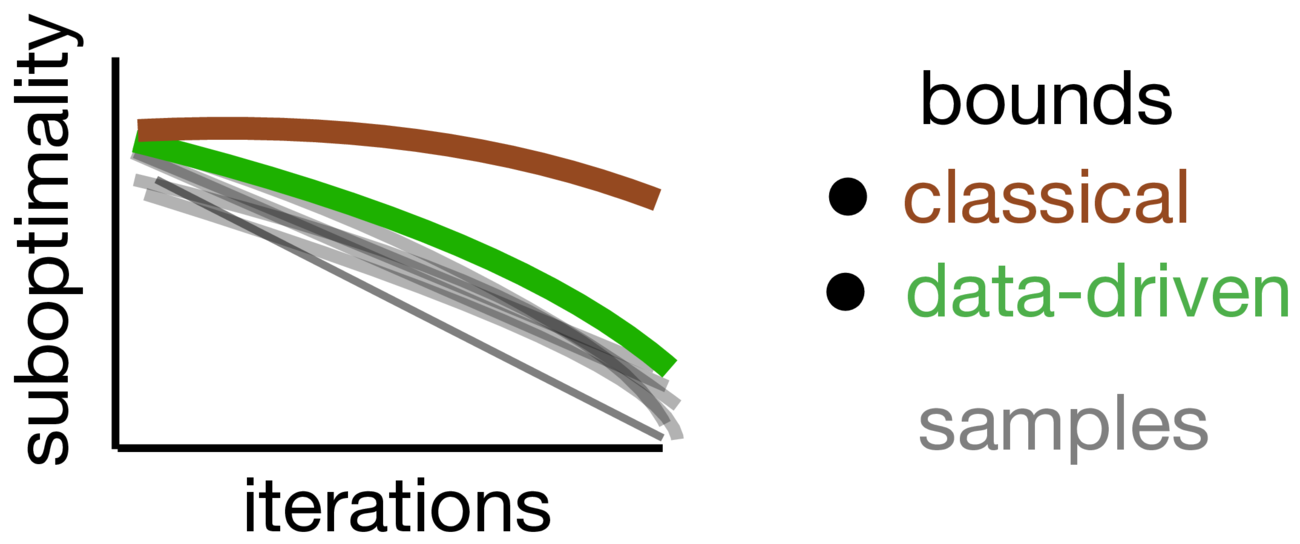
I use data to derive sharper, instance-specific performance bounds for optimization algorithms, going beyond the loose worst-case guarantees given by classical analysis.
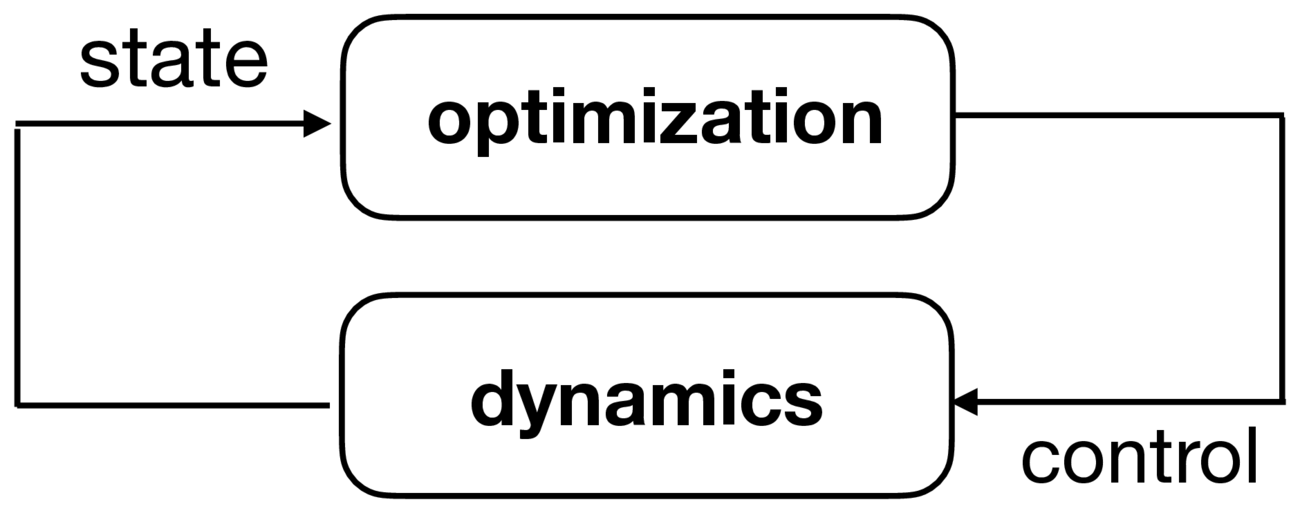
I study how these learned and data-driven optimization tools behave when embedded inside a feedback loop with dynamics, as in model predictive control.
Tools I rely on
Throughout my research, I rely on a wide variety of tools: first-order methods, convex optimization, bilevel optimization, deep learning, statistical learning theory, online learning, and model predictive control to name a few.